

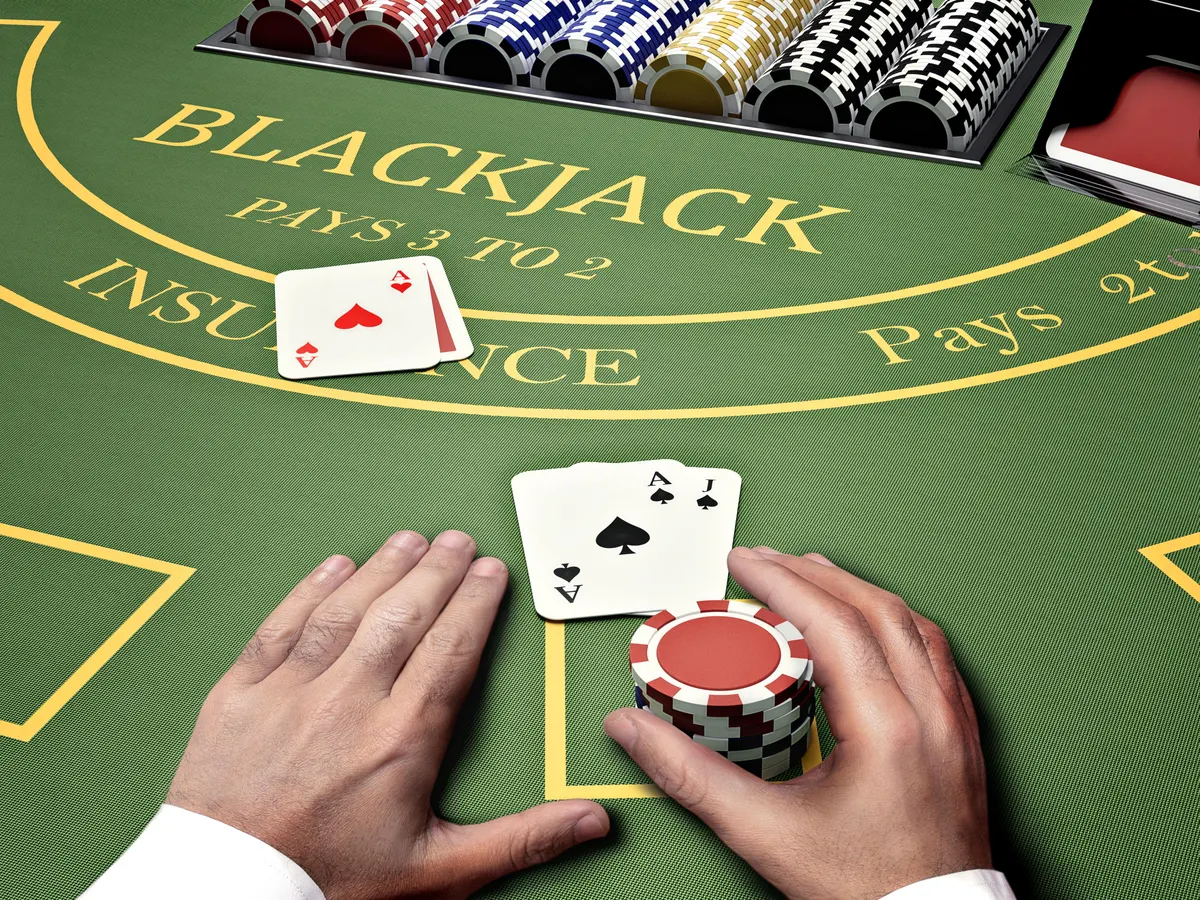
In blackjack, the dealer plays based on set rules that they must follow, with no discretion for individual dealers to have a different style of play.
Many new players ask how the dealer plays in blackjack because the answer shapes every decision at the table. The short version is that the dealer has no choices. Every action follows a fixed script set by the casino.
That script is the reason basic strategy works. Once you know how the blackjack dealer acts, you can make smarter calls on your own hand.
The Dealer’s Basic Script
A blackjack dealer follows one core rule. They must hit any total of 16 or less and stand on 17 or more. There is no judgment involved. It does not matter how many players are at the table or how much money is on the felt.
If the dealer holds 16, they take a card. If they hold 17, they stop. Players, by contrast, can stand on 12, double on 11, or split pairs.
| Dealer Total | Dealer Action |
|---|---|
| 2 to 16 | Must hit |
| 17 to 21 | Must stand |
| Over 21 | Busts, remaining players win |
How the Deal Works
The dealer deals two cards to each player and two to themselves. One dealer card is face up (the upcard) and the other is face down (the hole card). In most US-style games, the dealer checks the hole card for blackjack when the upcard is an ace or a ten-value card.
If the dealer has blackjack, the round ends at once and players lose unless they also have blackjack. A tie is a push, and the bet is returned.
The dealer then plays out the hand only after every player has finished acting. That order matters. Players must decide before seeing the rest of the dealer’s cards.
Soft 17: The Rule That Changes the Odds
The one variation in dealer rules is how they treat a soft 17. A soft 17 is a hand that contains an ace counted as 11, such as ace and six.
- Stand on soft 17 (S17): the dealer stops on all 17s. This is better for players.
- Hit soft 17 (H17): the dealer takes another card on ace and six. This favors the house.
The H17 rule adds roughly 0.2% to the house edge. On $10,000 of total bets, that is about $20 in extra expected loss. It sounds small, but it adds up over a long session.
Always check the table sign before you sit down. It usually reads “Dealer Must Stand on All 17s” or “Dealer Hits Soft 17.”
How Often the Dealer Busts
The dealer’s fixed rules mean their busting chances depend heavily on the upcard. Across all upcards, the dealer busts about 28% of the time. That figure is the foundation of basic strategy.
| Dealer Upcard | Approximate Bust Chance |
|---|---|
| 2 | 35% |
| 3 | 37% |
| 4 | 40% |
| 5 | 42% |
| 6 | 42% |
| 7 | 26% |
| 8 | 24% |
| 9 | 23% |
| 10 | 21% |
| Ace | 17% |
A dealer showing a 5 or 6 is in the weakest position, so players should avoid risking a bust themselves. A dealer showing a 10 or ace is much stronger, which is why players often need to hit stiff hands like 12 to 16 against those cards.
A Worked Example
Say you hold 14 and the dealer shows a 6. The dealer will bust about 42% of the time, so the standard play is to stand and let the dealer take the risk. Now say you hold the same 14 and the dealer shows a 10. The dealer is likely to finish with a decent total, so basic strategy says to hit.
The hand is identical, yet the correct decision flips. The only thing that changed was your understanding of how the dealer plays.
Common Dealer Questions
Does the dealer ever make a choice? No. The actions are automatic and determined only by the cards.
Does the dealer have to stop at 17 if it hurts the casino? Yes. Even if standing at 17 loses to your 18, the dealer cannot draw again.
What does the dealer do against a blackjack? A natural pays 3:2, so a $20 bet wins $30. The dealer simply pays and collects the cards.
Why do players lose ties with a bust? If you bust, you lose immediately, even if the dealer later busts too. This rule is where the house gets its edge.
Insurance and Dealer Aces
When the dealer shows an ace, players may be offered insurance, which is a side bet that the dealer holds blackjack. It pays 2:1 and costs up to half your original bet.
The dealer has a ten-value card underneath roughly 31% of the time, which is less than the one-in-three needed to break even. That makes insurance a losing bet in the long run for ordinary players.
Key Takeaways
Understanding the dealer’s rules gives you a real edge in decision-making, even though it does not remove the house advantage. Remember these points:
- The dealer hits to 16 and stands on 17 in every case.
- Soft 17 rules vary by table, and S17 is better for you.
- The dealer busts about 28% of the time overall, and much more often on a 5 or 6.
- Players act first, which is the main source of the casino’s edge.
Learn the dealer’s script and you can pair it with basic strategy to play every hand with confidence.